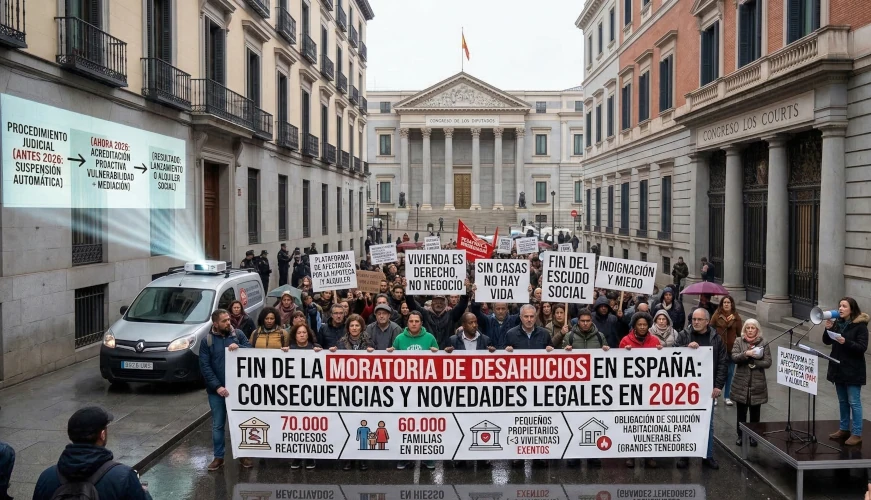
End of the eviction moratorium in Spain: Consequences and legal changes in 2026
At the end of February 2026, the real estate and procedural landscape in Spain has experienced one of the most significant changes in recent years: the definitive end of the eviction moratorium. After almost six years of consecutive extensions, the Congress of Deputies rejected the validation of the Government's latest decree-law, which means the immediate reactivation of thousands of legal proceedings that had been paralysed.
The Fall of the «Social Shield»
The mechanism known as the «social shield,» designed to protect vulnerable households without alternative housing from evictions, expired on 25 February 2026 following parliament's rejection of its validation. Although the Government attempted to extend this exceptional measure until 31 December 2026 through Royal Decree-Law 2/2026, a lack of political support led to its repeal. As a result, the courts no longer have the legal basis that underpinned the suspension of evictions due to economic vulnerability.
A level playing field for all owners
The decree that has just been overturned introduced a crucial innovation: it exempted small owners with one or two properties from the suspension, maintaining the freeze only for large holders. However, with the rule falling in its entirety, this distinction disappears. In the current legal scenario, both small savers and large holders have the same capacity to resume evictions and recover possession of their properties.
Return to the LAU and the Civil Procedure Law
From a procedural standpoint, the end of this extraordinary moratorium implies a strict return to the ordinary mechanisms established in the Urban Leases Law (LAU) and the Civil Procedure Law (LEC). The courts will reactivate litigation for:
Non-payment of rent.
Expiration of the legal term of the contract.
Illegal occupation (precarious tenancy).
Furthermore, a significant side effect of this repeal is that homeowners lose the right to claim financial compensation from the autonomous communities for the time their homes remained blocked.
Next procedural steps: What should those affected do?
The reactivation of evictions will not be automatic in all courts. For those landlords who have proceedings suspended since 2020 or subsequent years, it is imperative that their legal representation files a written request formally asking for the lifting of the suspension and the setting of a new date for the eviction.